
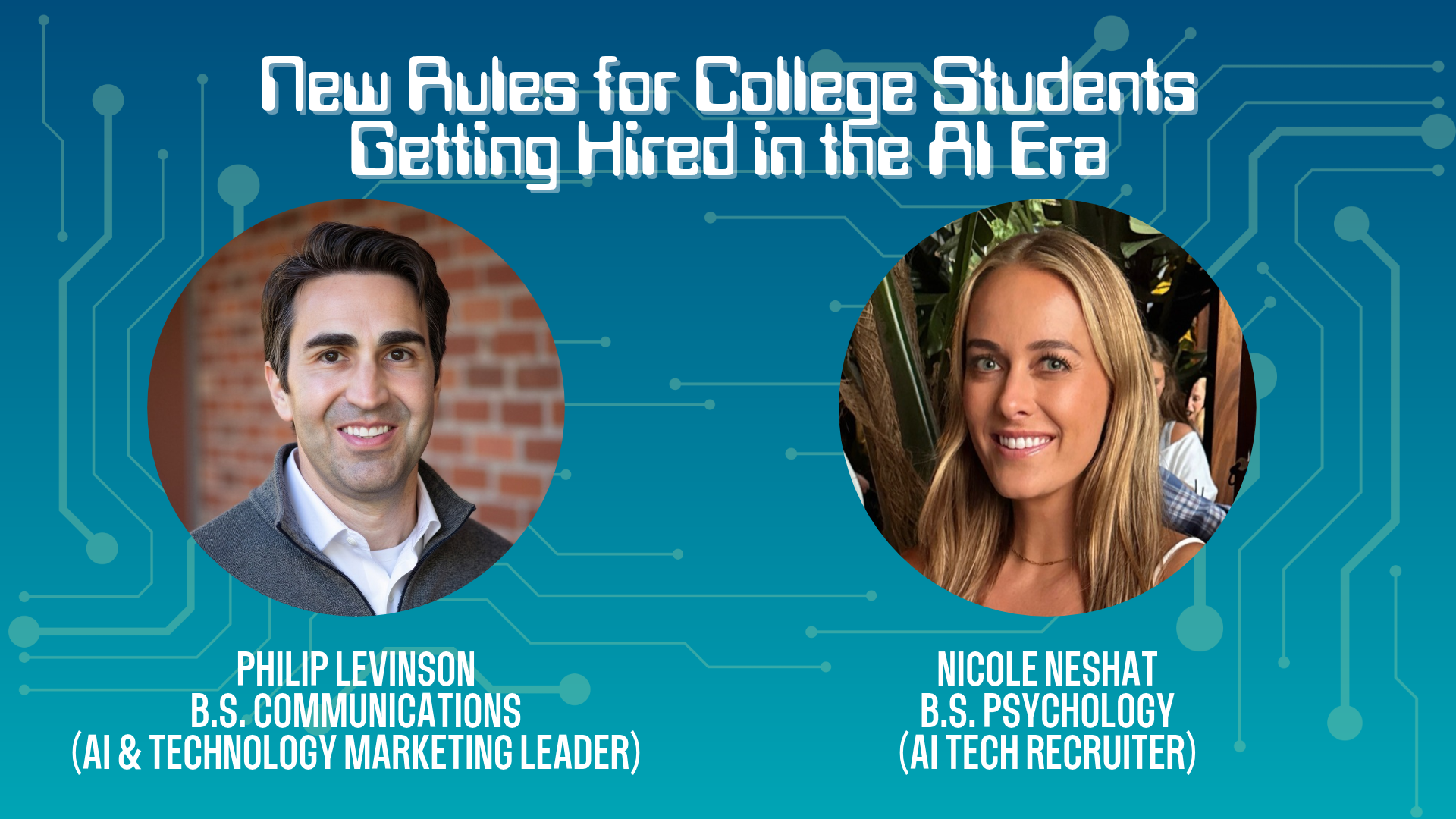
As artificial intelligence reshapes the job market, how can jobseekers adapt, stand out, and stay competitive? University of Oregon alumni Philip Levinson, BS (communications) and Nicole Neshat, BS (psychology) share three practical strategies for navigating an AI-driven workforce, from building AI fluency and demonstrating real-world skills to leveraging the power of professional connections.
Like it or not, today’s economy and job market show a key AI-related split. In August, 245,000 Americans ages 20-24 were unemployed -- the highest August figure for that group since 2014 -- with the unemployment rate for all workers in that age group reaching 7.1%, according to Labor Department data.
Meanwhile, unemployment among workers ages 22 to 34 without a college degree is near a 20-year low. What exactly is driving this divide?
“Skilled tradespeople are aging out of the workforce faster than they can be replaced,” writes Mary Jacob. “At the same time, more Americans than ever are graduating college, right as AI starts chewing through the entry-level tasks companies used to hand fresh grads.”
Indeed, we are at an AI-powered crossroads. So, how to navigate it?
Times Are Changing...Faster Than Ever
AI and automation are drastically changing hiring demands for college students and entry-level employees. But how? And what should college students do today to prepare and help ensure they have viable options when they enter the job market in spring 2027?
Admittedly, things are changing quickly. This is not the first transformational change we’ve seen. In the past 20 years, we’ve experienced the smartphone and mobile revolution plus a rapidly changing social media and online video boom. But what’s unique about this AI and agentic revolution is the magnitude and speed of the disruption to work and the economy.
As students and alums navigate these rapidly shifting AI winds, we’ve prepared three guidelines – or rules – that we follow ourselves and believe can help.
Rule #1: Develop an understanding of AI – and actually use it
In May 2023, Professor Richard Baldwin stood up at the World Economic Forum Growth Summit and famously said, “AI won’t take your job -- it’s someone using AI who will take your job.”
This is a very prescient and insightful guideline for prospective job-seekers. Indeed, students should become as AI fluent as possible. What this means is you can keep up by doing the following:
- Learn how AI is changing the field you want to enter and which skills employers increasingly value
- Stay curious about emerging AI tools and what they can and can't do well
- To whatever extent allowed, use AI in your coursework, projects, and everyday tasks, while building the judgment to evaluate its output
- Go beyond basic prompting: learn how AI tools and agents can be incorporated into real-world workflows
This does not mean you have to become an engineering or coding expert. Just as you don’t need to be a mechanic to drive a car, you don’t need to be an engineer or coding expert to use AI effectively. Becoming AI fluent is more accessible than you might think. A basic understanding of prompting and technology can help you start using AI, building your own agentic workflows, and putting you ahead of the curve.
Rule #2: Build something with AI
Knowing how to use AI is important. But in a job market where almost every applicant can now say they “use AI,” simply saying it is not enough. What tangible examples can you point to?
AI lowers barriers to entry. That’s the good news. It also means more people can build, create and compete, which makes things more competitive. The way to stand out is not just to learn AI, but to use it to solve a real problem and show what you built.
For example, if you’re in – or interested in – marketing and want to manage events that generate leads, build a workflow that helps handle event lead intake, organization, scoring, follow-up and coordination.
What you can build doesn’t need to be particularly elaborate. What matters is that you can explain the problem, why you chose to solve it, what you built, what worked, what didn’t -- and what you learned.
Think of it as proof of what you can do. Go beyond telling prospective employers you understand AI - show them something you’ve built with it. As AI becomes part of everyday work, demonstrating how you apply it will matter more than simply saying you know about it.
Rule #3: Use your unique role as a student or recent grad to ask
College students (and even recent graduates) have one career advantage they often underestimate: they are given more leeway and, essentially, a license to ask.
The U of O can help you make meaningful connections with professionals. Start with professors, alumni, career advisors, and career fairs to learn about the fields that interest you, identify relevant contacts, and seek introductions.
Take on school projects with real companies. Pursue internships and independent studies. Volunteer for a side project with a startup, nonprofit or business you admire. Offer to research a market, test an AI workflow, help with an event, analyze customer feedback or tackle some other problem the organization has not had time to solve. Focus on gaining hands-on experience that builds skills you can apply in the real world and delivers tangible results you can point to in interviews.
When reaching out to individuals in the corporate world, do it thoughtfully, with a clear reason for connecting and specific questions about their work. Getting paid or earning course credit can matter, but the greatest value comes from working with real organizations on real problems and learning how work actually gets done. You also begin building a network of people who know you and your work, rather than people who don’t know you and have only seen your résumé.
Former White House press secretary and television journalist Dana Perino put it this way: “Just start working -- wherever it is.”
Your first experience does not have to be perfect. What matters is getting started, learning and building relationships along the way. By graduation, the goal should not be to have only an academic record. You want stories. Projects. Examples. Results. People who know your work. And, ideally, a few examples of how you used AI along the way to accelerate your work and improve results. That combination is much harder for an employer to ignore.
Connecting the AI Dots
There’s one final paradox students should understand: as technical skills become easier to automate, human skills become more valuable -- not less. The people who stand out will increasingly be those who combine AI fluency with the ability to communicate, collaborate and solve problems with others. “The people who will thrive in this new era are the ones who balance technical fluency with the uniquely human ability to connect, collaborate, and solve complex problems,” said Marci Paino, Chief Learning Officer at Cisco.
That balance matters. AI fluency matters. But so does being a successful team player with strong cross-functional skills and knowledge. Develop durable learning and leading skills, as well as those “uniquely human abilities” cited by Paino, to keep up with the increasingly fast pace of AI-driven change.
Indeed, technology-driven change is unavoidable. The UO recently announced that Phil and Penny Knight committed $1 billion to the University of Oregon to establish a college of engineering located at the Phil and Penny Knight Campus for Accelerating Scientific Impact. This is the largest gift ever given to a comprehensive public university – and is in addition to other key examples of action and impact now flourishing at the UO.
There are clear implications for current Oregon students and recent alums.
Legendary Oregon track coach and Nike co-founder Bill Bowerman often shared an old saying about the pioneers who made the arduous journey west on the Oregon Trail. “The cowards never started, and the weak died along the way. That leaves us.”
Today, a new uncharted trail lies ahead – this one forged in AI and automation. AI is changing how careers begin and how work gets done. The students who start navigating this journey now will be far better prepared for the twists and turns of the trail ahead.
About the Authors
Philip Levinson is a Silicon Valley-based marketing and technology executive who has helped build and scale several AI and software companies, including Ambient.ai, EdCast, and TigerConnect, with the latter two being successfully acquired. He also co-leads HubSpot's "AI & Automation in Sales & Marketing" User Group. His previous article for UO explored the life and legacy of legendary Oregon track and field coach Bill Dellinger.
Nicole Neshat is originally from San Diego, CA, and graduated from the University of Oregon with a degree in psychology. Second to being a mom to her Maltipoo, Princess, she has spent the last decade building engineering teams at cutting-edge technology companies.